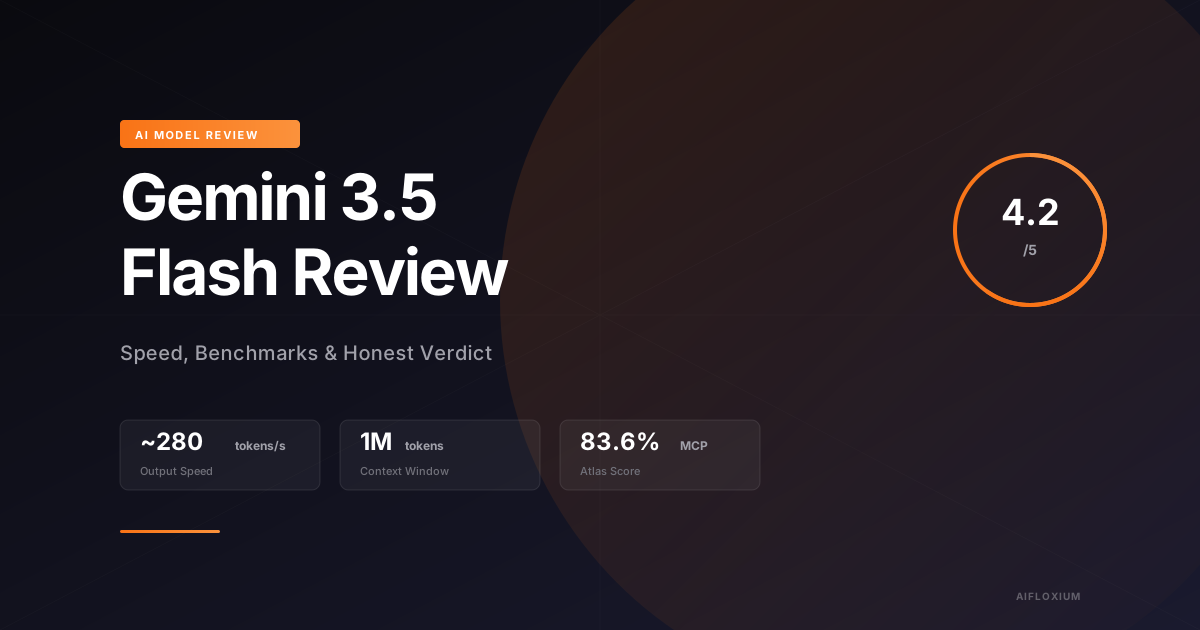
Gemini 3.5 Flash (GA May 19, 2026) is the fastest frontier-class model I have ever used: ~4x the output speed of comparable frontier models and a 1M-token context window, with near-Pro intelligence (Artificial Analysis Intelligence Index of 50, vs a tier median of 29). It is genuinely best-in-class for agentic and MCP workflows (83.6% MCP Atlas, 56.5% Toolathlon — both category-leading). But there is a catch nobody puts on the marketing page: it is a token hog. The price tripled vs Gemini 3 Flash (now $1.50 in / $9.00 out per 1M tokens), and because it "thinks" and outputs so much, real-world bills can balloon. Best for: high-volume agentic automation, rapid prototyping, and long-horizon coding with supervision. Skip it for: budget-sensitive high-volume jobs (use Flash-Lite) and creative roleplay. My score: 4.2 / 5.
The 30-second answer
What is Gemini 3.5 Flash?
Gemini 3.5 Flash is the first model in Google's Gemini 3.5 family, announced at Google I/O 2026 and made generally available on May 19, 2026. Google's framing is deliberate: "frontier intelligence with action." It is not pitched as the smartest model on every reasoning leaderboard — it's the model built to do things: drive agents, write and verify code, and run long-horizon workflows at a speed and cost that make those things economical at scale. You can try it free in the Gemini app or build with it in Google AI Studio.
A few things make this release notable:
- It is a Flash-tier model that outperforms the previous generation's Pro model (Gemini 3.1 Pro) on most coding and agentic benchmarks.
- It was built for the agentic era — sub-agent deployment, multi-step workflows, and rapid agentic loops are first-class use cases, not afterthoughts.
- Google says 3.5 Pro is already in internal use and ships next.
Gemini 3.5 Flash specs at a glance
| Spec | Detail |
|---|---|
| Release date | May 19, 2026 (Generally Available, stable) |
| Model ID | gemini-3.5-flash |
| Context window | 1,000,000 tokens |
| Max output | ~64K–65K tokens |
| Inputs | Text, images, audio, video, PDF (multimodal) |
| Output | Text only |
| Knowledge cutoff | January 2025 |
| Speed | ~150 t/s (Artificial Analysis "high"); up to ~280 t/s floor target; ~4x faster than comparable frontier models |
| Intelligence Index | 50 (Artificial Analysis; tier median 29) |
| Thinking | Configurable effort: low / medium (new default) / high; automatic thought preservation across turns |
| Tooling | Function calling, structured output, code execution, search-as-a-tool (all first-party). Computer Use not supported yet. |
| Pricing | $1.50 input / $9.00 output per 1M tokens; $0.15 context caching |
| Where to use | Gemini app, AI Mode in Search, Google AI Studio, Gemini API, Antigravity, Android Studio, Gemini Enterprise, Make, OpenRouter |
Benchmarks: how good is it, really?
Here's Google's own published benchmark table (DeepMind model card), with the competitive set. I've kept the numbers exactly as published — the bold winners are noted in the text below.
| Benchmark (what it measures) | Gemini 3.5 Flash | Gemini 3 Flash | Gemini 3.1 Pro | Claude Opus 4.7 | GPT-5.5 |
|---|---|---|---|---|---|
| Terminal-bench 2.1 (agentic terminal coding) | 76.2% | 58.0% | 70.3% | 66.1% | 78.2% |
| SWE-Bench Pro, Public (agentic coding) | 55.1% | 49.6% | 54.2% | 64.3% | 58.6% |
| MCP Atlas (multi-step MCP workflows) | 83.6% | 62.0% | 78.2% | 79.1% | 75.3% |
| Toolathlon (real-world tool use) | 56.5% | 49.4% | — | — | 55.6% |
| MMMU-Pro (multimodal reasoning) | 83.6% | 81.2% | 80.5% | 75.2% | 81.2% |
| Blueprint-Bench 2 (spatial reasoning) | 33.6% | 0.0% | 26.5% | 24.5% | 36.2% |
| CharXiv Reasoning | 84.2% | — | — | — | — |
How to read this:
- Agentic / tool use is where it wins outright. It tops the table on MCP Atlas (83.6%), Toolathlon (56.5%), and MMMU-Pro (83.6%) — beating Gemini 3.1 Pro, Claude Opus 4.7, and GPT-5.5. If your work is agents calling tools and MCP servers, this is the standout result.
- Coding is strong but not the outright king. On Terminal-bench 2.1 (76.2%) it edges past 3.1 Pro and Opus 4.7 but trails GPT-5.5 (78.2%). On SWE-Bench Pro (55.1%) it sits behind both Opus 4.7 and GPT-5.5 — Opus is still the heavyweight for hard, single-shot software engineering.
- It is a massive jump over Gemini 3 Flash. Across the board the deltas vs the prior Flash are large (e.g., MCP Atlas 62% → 83.6%, Blueprint-Bench 0% → 33.6%).
Third-party data backs this up. On the Appwrite Arena backend benchmark it scored 90.70 overall and finished in 13 minutes — the fastest model in the entire 90+ point top tier, at $1.14 per run. Artificial Analysis pegs its Intelligence Index at 50, comfortably above the ~29 median for its price tier.

Speed: this is the headline, and it's real
Google claims Gemini 3.5 Flash is 4x faster than other frontier models in output tokens per second. In my testing this was not marketing fluff. Independent measurements put it at roughly:
- ~150 tokens/second on the Artificial Analysis "high" configuration
- ~127 tokens/second on OpenRouter's throughput test
- ~280 tokens/second as Google's stated floor-speed target
What that feels like: I asked it to generate six different payment-UI variations, and it produced all six in under a minute. Spinning up multi-agent loops in Antigravity, the models finished faster than I could read their output. One developer on LinkedIn put it perfectly: "the Human is now officially the bottleneck — reviewing the output takes more time than it took the model to generate it."

Pricing: the part nobody puts on the marketing slide
This is the most important section of the review, so don't skip it.
| Cost component | Gemini 3 Flash (previous) | Gemini 3.5 Flash (new) |
|---|---|---|
| Input (per 1M tokens) | $0.50 | $1.50 |
| Output (per 1M tokens, incl. thinking) | $3.00 | $9.00 |
| Context caching | — | $0.15 |
| Effective change | baseline | ~3x more expensive |
The sticker price tripled. But the real cost is worse than the sticker, because Gemini 3.5 Flash thinks more and outputs more. A widely-shared r/LLMDevs post (flagged by Simon Willison) ran the same Artificial Analysis benchmark suite on both models:

Multiple Antigravity users echoed this. One on the Google AI dev forum wrote: "I now know why Gemini 3.5 is called Flash" — not for speed, but because it burns through token quota faster than any model they'd used, getting 1 issue resolved per usage bar vs 5 issues per bar on the pricier Opus 4.6. The lesson: fast + token-hungry can be more expensive than slow + efficient.
Gemini 3.5 Flash vs the competition
| Model | Input / Output (per 1M) | Context | Best at | Watch out for |
|---|---|---|---|---|
| Gemini 3.5 Flash | $1.50 / $9.00 | 1M | Speed, agentic/MCP, multimodal, prototyping | Token consumption; sloppy when rushed |
| GPT-5.5 | mid-tier | large | Hard coding (Terminal-bench 78.2%), mature Codex/ChatGPT ecosystem | Slower than Flash; pricier per task |
| Claude Opus 4.7 | premium (~$3 / $15+) | 1M | Hardest single-shot SWE (SWE-Bench Pro 64.3%), careful reasoning | Far more expensive; slower |
| Claude Haiku 4.5 | cheaper than Flash | no 1M / multimodal | Cheap output-heavy coding (SWE-bench Verified 73.3%) | No 1M context, no multimodal |
| Gemini 3.1 Flash-Lite | lowest | large | High-volume, low-cost, efficiency | Lower reasoning depth than 3.5 |
Quick decision guide:
- Pick Gemini 3.5 Flash if you need speed + agentic/tool performance + multimodal + 1M context, and you can supervise spend.
- Pick GPT-5.5 if you live in the Codex/ChatGPT ecosystem and want the strongest single-shot coding.
- Pick Claude Opus 4.7 for the hardest engineering tasks where accuracy beats speed and budget is no object.
- Pick Claude Haiku 4.5 for cheap, output-heavy coding that doesn't need 1M context or multimodal.
- Pick Gemini 3.1 Flash-Lite for the cheapest high-volume workloads.
What developers actually say (Reddit, LinkedIn, Hacker News, Quora)
I read through dozens of real threads. The sentiment is genuinely split, and the divide is almost always speed-lovers vs cost-watchers.
Best real-world use cases
From Google's demos and my own testing, this is where Gemini 3.5 Flash shines:
- Agentic automation & MCP workflows — its strongest category. Multi-step tool use, sub-agent orchestration, long-horizon tasks. See the MCP docs for protocol details.
- Rapid prototyping — generating multiple UI/app variations in seconds to explore options.
- Codebase modernization — Google demoed transforming a messy legacy codebase to Next.js via the Antigravity harness.
- High-volume document processing — multimodal ingestion of PDFs, images, audio, and video at scale (now available in Make for automations).
- Builder + player loops — two agents collaborating in a rapid self-improvement loop (e.g., coding a playable game).
- Search-grounded answering — first-party search-as-a-tool and grounding with Google Search / Maps.
How to use Gemini 3.5 Flash (step-by-step)
Option 1 — Free, no code (Gemini app / AI Studio)
- Try it in 60 seconds
- Open the Gemini app or AI Mode in Google Search — 3.5 Flash is free for everyone there.
- For building/prototyping, go to Google AI Studio, pick
gemini-3.5-flashfrom the model dropdown, and start prompting. The free tier has no charge for input/output (with rate limits). - Adjust the thinking effort (low / medium / high) to trade speed for depth.
Option 2 — Gemini API (developers)
- Get an API key and make your first call
- In Google AI Studio, create an API key and set it as an environment variable.
- Install the Google Gen AI SDK for your language (Python, TypeScript, Go, Java, etc.).
- Call the model with ID
gemini-3.5-flash. Minimal Python example:
1from google import genai2 3client = genai.Client() # reads GEMINI_API_KEY from env4 5response = client.models.generate_content(6 model="gemini-3.5-flash",7 contents="Summarize this quarterly report and list 3 risks.",8 config={9 "thinking_config": {"thinking_level": "low"}, # control cost!10 "max_output_tokens": 2048,11 },12)13print(response.text)- For agentic workloads, Google recommends the new Interactions API (built for background tasks and long-running agents), but the GenerateContent API above works for most use cases.
- Migration note: the default thinking effort changed from
hightomedium. If you migrated from Gemini 3 Flash and your bills jumped, this (plus the price change) is why — set it explicitly.
Option 3 — Inside an agent IDE (Antigravity / Android Studio / Cursor)
- Use it for agentic coding
- In Google Antigravity (Google's agent-first IDE), select Gemini 3.5 Flash as your model. This is where its sub-agent and long-horizon strengths show best.
- Always write an implementation plan first and verify it before you let the agent execute — multiple devs report that a solid plan makes the failure rate very low, while skipping it leads to runaway token use.
- It's also available in Android Studio, Cursor, OpenRouter, and Make for automation workflows.
Pros and cons
| Pros | Cons |
|---|---|
| Fastest frontier-class model (~4x output speed) | 3x price increase vs Gemini 3 Flash |
| Best-in-class agentic / MCP performance | Token-hungry — real bills can be ~5x higher |
| 1M-token context + full multimodal input | Sloppy / error-prone when run too fast |
| Beats Gemini 3.1 Pro on most benchmarks | Not the best for hardest single-shot coding |
| Free in Gemini app & Search AI Mode | No Computer Use support yet |
| Huge intelligence-per-dollar on paper | Weak for creative roleplay / long-form fiction |
Final verdict
Keep reading
Frequently Asked Questions
Yes — it's free to use in the Gemini app and AI Mode in Google Search, and the Google AI Studio free tier has no input/output charge (with rate limits). API usage on the paid tier costs $1.50 per 1M input tokens and $9.00 per 1M output tokens.
On most coding and agentic benchmarks, yes — and it's faster and cheaper. For the very hardest reasoning tasks a full Pro/flagship model can still edge ahead, but for the majority of real-world agentic and coding work, 3.5 Flash is the better practical choice.
Roughly 150–280 tokens per second depending on configuration — about 4x faster than comparable frontier models in output speed, and the fastest model in the top tier of the Appwrite Arena benchmark (13-minute run).
Two reasons: the price tripled vs Gemini 3 Flash ($1.50/$9.00 per 1M tokens), and the model generates a lot of thinking + output tokens. Real-world benchmark runs cost ~5.5x more than Gemini 3 Flash. Fix it by setting thinking effort to low/medium, capping max output tokens, using context caching, and routing cheap work to Flash-Lite.
1,000,000-token context window with up to ~64K output tokens, and a knowledge cutoff of January 2025. It accepts text, images, audio, video, and PDFs as input.
Not at the moment. It supports function calling, structured output, code execution, and search-as-a-tool, but Computer Use is not yet available for this model.
Yes for agentic and iterative coding (Terminal-bench 2.1 76.2%, MCP Atlas 83.6%), especially inside [Antigravity](/blog/google-antigravity-2-0-review-2026) with a clear implementation plan. For the hardest single-shot software-engineering tasks, Claude Opus 4.7 and GPT-5.5 still score higher on SWE-Bench Pro. It can also be error-prone when run too fast, so review its output.
Choose Gemini 3.5 Flash for speed, agentic/MCP workflows, multimodal input, and a 1M context at lower cost. Choose GPT-5.5 if you're already in the Codex/ChatGPT ecosystem and want the strongest single-shot coding (it leads Terminal-bench at 78.2%).
Muhammad Shadab Shams
AI Automation Consultant & Software Engineer
I architect agentic operating systems and build production-grade AI workflows at AIFLOXIUM. This review is based on 3 weeks of hands-on testing across Google AI Studio, the Gemini API, and Google Antigravity on real coding, scraping, and multi-agent workloads, cross-referenced with the Google DeepMind model card, Artificial Analysis, Appwrite Arena, OpenRouter, and primary developer discussion on Reddit, LinkedIn, Hacker News, and Google's AI dev forum.
Review methodology
This review combines ~3 weeks of hands-on testing across Google AI Studio, the Gemini API, and Google Antigravity on real coding, scraping, and multi-agent workloads, cross-referenced with the Google DeepMind model card, Artificial Analysis, Appwrite Arena, OpenRouter, and primary developer discussion on Reddit, LinkedIn, Hacker News, and Google's AI dev forum. Benchmark figures are quoted as published by their sources as of June 2026. Pricing reflects Google's published API rates at the time of writing and may change.