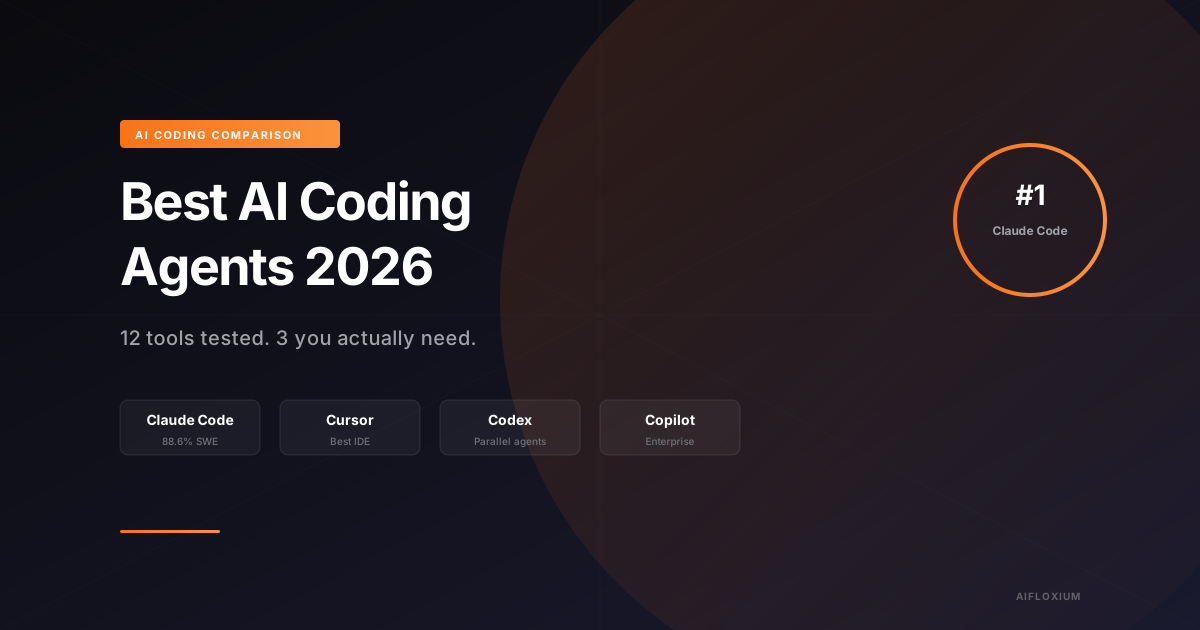
There is no single "best" AI coding agent anymore — the winners are Claude Code (best code quality + autonomy), Cursor (best all-in-one IDE experience), and OpenAI Codex (best parallel multi-agent runs). GitHub Copilot is still the safest enterprise default, Windsurf (now Devin Desktop) is the best-value autonomous IDE, and Cline is the best free/open-source option. Most working devs on Reddit run two or three of these together.
The 30-second answer
If you just want a recommendation without reading 4,000 words:
- Best overall code quality + agentic autonomy: Claude Code (Opus 4.8)
- Best AI-native IDE for daily flow: Cursor
- Best for running many agents in parallel: OpenAI Codex (GPT-5.5)
- Safest enterprise default + widest IDE support: GitHub Copilot
- Best value autonomous IDE: Windsurf / Devin Desktop
- Best free / open-source / bring-your-own-key: Cline
- Best Google-ecosystem agent: Google Antigravity 2.0 (Gemini 3.5 Flash)
- Most autonomous "hire-an-engineer" agent: Devin
The honest truth, echoed all over Reddit in 2026: most senior developers don't pick one. They run a two- or three-tool stack — typically Cursor for inline edits, Claude Code for heavy architectural work, and Codex or Windsurf for background/parallel tasks.

How I ranked them
I scored every tool on six dimensions that actually predict whether you'll keep using it:
- Code quality — does the output compile, pass tests, and match your conventions?
- Agentic autonomy — can it plan, edit across many files, run tests, and open a PR with minimal babysitting?
- Context / repo understanding — how well does it hold a large codebase in its head?
- Developer experience — friction, diffing, review controls, speed.
- Price predictability — can you forecast the bill, or does it spike?
- Ecosystem / IDE reach — where it runs and how mature the integrations are.
The ranking: 12 best AI coding agents in 2026
1. Claude Code — best code quality and autonomy
Claude Code (now running Opus 4.8) is the tool that shows up most often in "I switched and never went back" threads on r/ClaudeAI and r/vibecoding. It's a terminal-native agent (with VS Code/JetBrains extensions) that genuinely delegates: you describe a task, it plans, edits across files, runs tests, and reports back.
- Best for: complex refactors, new features from scratch, deep debugging, autonomous multi-file work.
- Reddit consensus: "Cursor makes you faster at what you already know; Claude Code does things for you." Heavy users report that Max at $200/mo replaces thousands of dollars of API usage — one dev claimed ~$800 over 8 months on Max vs an estimated $15,000+ on pay-per-token.
- Benchmarks: Opus 4.8 scores 88.6% on SWE-bench Verified (vs 87.6% for Opus 4.7), near the top of every public leaderboard.
- Watch out for: token burn. Always-on Thinking can drain context fast, and unmonitored sub-agent fan-out has produced horror-story bills. Pick the right plan and cap effort.
My take: If I could keep only one agent for serious engineering, it's this. See my full Claude Opus 4.8 review for the deep dive on the model behind it.
2. Cursor — best AI-native IDE experience
Cursor is the most complete package and still dominates mindshare on Reddit and Hacker News. It's a VS Code fork with best-in-class tab autocomplete, inline diffing, Composer, background agents, and .cursor rules to keep the AI on-convention.
- Best for: developers who want AI embedded in their editor with visual accept/reject on every change.
- Reddit consensus: "Cursor is still the most complete package" — fastest autocomplete, up to 8 parallel background agents, the most mature MCP ecosystem, and "1M+ users means there's always a thread with your exact problem."
- Watch out for: pricing. Since the June 2025 shift to usage-based credits, complaint threads are constant — heavy users blow past the $20 Pro pool and land on overages ("$40-50/mo after overages" is a common report).
3. OpenAI Codex — best for parallel multi-agent work
Codex (powered by GPT-5.5, up from GPT-5.4) became genuinely production-grade in 2026. OpenAI was named a Leader in Gartner's 2026 Magic Quadrant for Enterprise AI Coding Agents, and Codex reportedly serves 4M+ weekly users (Cisco, Datadog, Dell, NVIDIA).
- Best for: firing off multiple agents at once ("refactor auth," "add rate limiting," "update tests") and reviewing PRs.
- Benchmarks: GPT-5.4 hit 57.7% on SWE-bench Pro and led OSWorld at 75.0%; GPT-5.5 improved code quality further.
- Watch out for: weekly limits. The single loudest Reddit gripe — "the $20 weekly limits disappear in ~2 days, even on lighter models."
4. GitHub Copilot — safest enterprise default
Still the industry standard and the broadest: 10+ IDEs, the widest model selector, mature SSO/audit/policy controls, and an agent mode. Quora's recurring verdict: "best for developers who want inline suggestions that just work."
- Best for: enterprises, mixed-stack teams, and anyone who wants "it just works" with minimal setup.
- 2026 change: moved to usage-based billing (GitHub AI Credits, 1 credit = $0.01). Base seats unchanged — Pro $10, Pro+ $39, Business $19/user, Enterprise $39/user, plus a new Max at $100 — but heavy agentic use now consumes credits.
- Watch out for: the billing change triggered a 600+ comment backlash; predictability is the concern, not base price.
5. Windsurf (now Devin Desktop) — best value autonomous IDE
Windsurf was acquired into Cognition and rebranded Devin Desktop. Its Cascade agent auto-indexes your codebase, and it remains the budget-conscious favorite.
- Best for: autonomous, "don't make me babysit it" agent workflows in a clean IDE.
- Reddit consensus: the budget stack is Windsurf ($20 Pro) + GitHub Copilot ($10) — "together they cover ~90% of what Cursor does." The free tier is still the most generous in the market.
- Watch out for: the March 2026 price bump moved Pro from $15 to $20, erasing its main price gap vs Cursor; context window still trails Cursor on very large repos.
6. Cline — best free / open-source agent
Open-source, model-agnostic, bring-your-own-API-key. Cline (and its cousin Roo Code) is the darling of devs who refuse to be locked in.
- Best for: privacy, control, and avoiding subscription lock-in.
- Proof point: independent testers reported Cline + Claude API scoring 80.8% on SWE-bench Verified — frontier-level from a $0 tool (you pay only API costs, ~$20-50/mo for most).
- Watch out for: you manage your own keys and costs; less hand-holding than a polished IDE.
7. Google Antigravity 2.0 — best Google-ecosystem agent
Google's agent-first platform, refreshed at I/O 2026 with Antigravity 2.0 and Gemini 3.5 Flash as default. Its standout idea is Artifacts — agents produce task lists, plans, screenshots, and browser recordings you can comment on like a doc.
- Benchmarks: Gemini 3.5 Flash posts Terminal-Bench 2.1 76.2% and MCP-Atlas 83.6%, and runs up to 12x faster on Antigravity (limited-time optimization).
- Watch out for: Reddit reports the $20 tier limits are too low, with sessions disconnecting during peak hours. (I cover the platform in depth in my Antigravity 2.0 review.)
8. Devin — most autonomous "AI engineer"
Devin (Cognition) is the closest thing to hiring a junior engineer: it plans, executes, debugs, deploys, and monitors. Jira/Linear integrations make it a real teammate for ticket-driven work.
- Pricing: Core from $20/mo; the Teams plan jumps to $500/mo (with API access and more compute).
- Watch out for: cost at the Teams tier, and you still review everything it ships.
9. Kiro — spec-driven newcomer
AWS-flavored, spec-and-credit-based agent that shows up in 2026 comparison roundups (kiro.dev). Good for structured, spec-first builds; the credit model needs watching.
10. Gemini CLI — free terminal agent
Google's free terminal agent (github.com/google-gemini/gemini-cli) with MCP and SKILL.md support. A solid no-cost option for quick, focused tasks if you're already in Google's ecosystem.
11. Amazon Q Developer — best for AWS-heavy teams
Genuinely strong on AWS-specific work (CloudFormation, IAM, S3/Lambda debugging). Outside AWS, testers found suggestions more generic.
12. Aider — best minimalist CLI
The lightweight, scriptable, git-native CLI agent (aider.chat). Beloved by terminal purists who want a focused tool that pairs with any model.
Quick comparison table
| Tool | Type | Best for | Autonomy | Starting price (June 2026) |
|---|---|---|---|---|
| Claude Code | Terminal agent + IDE ext | Code quality, refactors | Very high | $20 (Pro) to $200 (Max 20x) |
| Cursor | AI-native IDE | Daily inline editing | High | $20 (Pro) |
| OpenAI Codex | Multi-surface agent | Parallel agent runs | Very high | Incl. in ChatGPT plans / API |
| GitHub Copilot | IDE assistant + agent | Enterprise default | Medium-high | $10 (Pro) |
| Windsurf / Devin Desktop | AI-native IDE | Value autonomy | High | $20 (Pro) |
| Cline | Open-source agent | Free / BYO key | High | Free + API (~$20-50) |
| Google Antigravity 2.0 | Agent-first platform | Google ecosystem | Very high | Free tier + paid |
| Devin | Autonomous AI engineer | Ticket-driven builds | Highest | $20 (Core) to $500 (Teams) |
| Gemini CLI | Terminal agent | Free quick tasks | Medium | Free |
| Amazon Q | IDE assistant | AWS work | Medium | Free tier + paid |
| Cline/Roo Code | Open-source | Privacy/control | High | Free + API |
| Aider | CLI agent | Minimalist terminal | Medium | Free + API |
Pricing breakdown (June 2026)
| Tool | Free tier | Individual paid | Team / Enterprise | Billing model |
|---|---|---|---|---|
| Claude Code | No (chat only) | Pro $20, Max 5x $100, Max 20x $200 | Team Premium $100/seat, Enterprise custom | Subscription pools + API option |
| Cursor | Hobby (free) | Pro $20, Pro+ $60, Ultra $200 | Teams $40/seat (Std), Premium $120/seat | Usage-based credits (since 2025) |
| GitHub Copilot | Free (limited) | Pro $10, Pro+ $39, Max $100 | Business $19/user, Enterprise $39/user | Usage-based AI Credits (June 2026) |
| Windsurf / Devin Desktop | Yes (generous) | Pro $20, Max $200 | Teams $40/seat | Daily/weekly quota |
| Devin | No | Core $20 | Teams $500/mo, Enterprise custom | ACU / compute-based |
| Cline | Yes (open source) | API costs only (~$20-50) | Self-hosted | Bring-your-own API key |
| Antigravity 2.0 | Yes | Paid tiers (post-I/O 2026) | Cloud/enterprise | Tiered + Gemini usage |
Benchmarks: what the leaderboards actually say (and where they lie)
| Model / tool | SWE-bench Verified | SWE-bench Pro | Terminal-Bench | Notes |
|---|---|---|---|---|
| Claude Mythos Preview | 93.9% | — | — | Top of leaderboard (late May 2026) |
| Claude Opus 4.8 (Claude Code) | 88.6% | 69.2% | 74.6% | Best daily-driver code quality |
| Claude Opus 4.7 | 87.6% | 64.3% | 66.1% | Prior flagship |
| GPT-5.4 / 5.5 (Codex) | ~85% | 57.7% | 65.4% | Leads OSWorld at 75.0% |
| Gemini 3.5 Flash (Antigravity) | — | — | 76.2% | MCP-Atlas 83.6%, 12x faster on AG |
| Cline + Claude API | 80.8% | — | — | Frontier score from a $0 tool |
What developers actually say (Reddit, LinkedIn, Quora)
Marketing pages all say the same thing. Here's what real practitioners report across platforms in 2026:
Which AI coding agent should you pick? (decision matrix)
| If you are... | Pick this | Add this |
|---|---|---|
| A solo dev who wants the best code, money no object | Claude Code (Max) | Cursor for inline edits |
| On a tight $20-40/mo budget | Windsurf / Devin Desktop | GitHub Copilot ($10) |
| An enterprise standardizing org-wide | GitHub Copilot Business/Enterprise | Claude Code for power users |
| Running many tasks in parallel | OpenAI Codex | Claude Code subagents |
| Privacy-first / anti-lock-in | Cline (BYO key) | Aider / Gemini CLI |
| All-in on Google / Gemini | Antigravity 2.0 | Gemini CLI |
| Deep in AWS | Amazon Q Developer | Cursor or Copilot |
| Delegating whole tickets end-to-end | Devin | Claude Code for review |
Honest gripes (no tool is perfect)
- Cursor: usage-based billing is still the #1 complaint; power users hit overages fast.
- Claude Code: token/context burn is real — budget your plan and watch sub-agent fan-out.
- Codex: weekly limits feel stingy relative to the $20 price.
- Copilot: the 2026 move to credits added unpredictability for heavy agentic users.
- Antigravity/Gemini: $20 tier throttling and peak-hour disconnects.
- Devin: the $500 Teams jump is steep; still needs human review.
- All of them: never blindly accept output — they suggest deprecated APIs, miss edge cases, and drift from your conventions. Review everything.
Keep reading
- Claude Opus 4.8 Review (2026)
- Agentic Workflows in n8n: Building Production-Grade Multi-Agent Systems
- AI Automation Cost Optimization: Cut Your n8n + LLM Bill by 80%
Frequently Asked Questions
For raw code quality and autonomy, Claude Code (Opus 4.8) is the top standalone pick, scoring 88.6% on SWE-bench Verified. For daily in-editor flow, Cursor wins; for parallel multi-agent runs, OpenAI Codex. Most professional developers run two or three together rather than choosing one.
They solve different problems. Cursor is an accelerator — it makes you faster at code you already understand, with great inline diffing. Claude Code is a delegator — you hand it a task and it executes across files autonomously. Many devs use Claude Code to build and Cursor to refine.
The Reddit-favorite budget stack is Windsurf / Devin Desktop Pro ($20) + GitHub Copilot ($10), which covers about 90% of Cursor's capability. For $0 base cost, Cline + a Claude API key scored 80.8% on SWE-bench Verified — you only pay metered API usage (~$20-50/mo for most).
Directionally, yes; literally, no. SWE-bench Verified scores in the high 80s/90s overstate real reliability. SWE-bench Pro — which uses long-horizon, multi-file tasks — drops top models to the 57-69% range, which matches how the tools actually feel day to day.
Base seat prices stayed the same (Pro $10, Pro+ $39, Business $19, Enterprise $39, new Max $100), but Copilot moved to usage-based AI Credits (1 credit = $0.01). Code completions are unchanged; heavy agentic usage now consumes credits, so bills are less predictable for power users.
Windsurf was acquired by Cognition (makers of Devin) and rebranded Devin Desktop. It kept the Cascade agent and clean IDE, but a March 2026 price increase moved Pro from $15 to $20, matching Cursor.
Yes, with guardrails. Start with Cursor or Copilot for guided, in-editor help, and always review and understand generated code before merging. Agents speed up routine work but can introduce subtle bugs and deprecated patterns.
Muhammad Shadab Shams
AI Automation Consultant & Software Engineer
I ship production agents and workflows for clients every week. For this guide I ran these tools on real client codebases, then cross-checked against hundreds of developer reports on Reddit, LinkedIn, Quora, and public benchmark leaderboards.
Methodology & sources
Rankings combine hands-on use on real client codebases with cross-referenced public data from: developer threads on Reddit (r/cursor, r/ClaudeAI, r/vibecoding, r/ChatGPTCoding, r/GithubCopilot, r/windsurf); LinkedIn engineering write-ups (including a 18-team, 6-month usage study); Quora coding-tool threads; and public benchmark leaderboards (SWE-bench Verified, SWE-bench Pro/Scale, Terminal-Bench, OSWorld, MCP-Atlas). Pricing verified against vendor pages as of June 2026. This is original analysis — community sentiment is summarized and attributed, not copied. Benchmarks and prices change frequently; dates are noted throughout.